Having taught geography in the same school for 10 years, the first national lockdown in March 2020 provided an opportunity to reflect on, and refine, many aspects of my teaching practice. In this short article I will outline my approach to teaching geography. Some of these insights have evolved over time, whereas some have developed more recently thanks to the work of others. For example, Oliver Caviglioli and David Rodger-Goodwin’s work on graphic organisers have inspired my teaching practice and helped me to codify my ideas about teaching geography, as shown below. Indeed, I will also include reflections on other approaches which I myself am only trying for the first time.
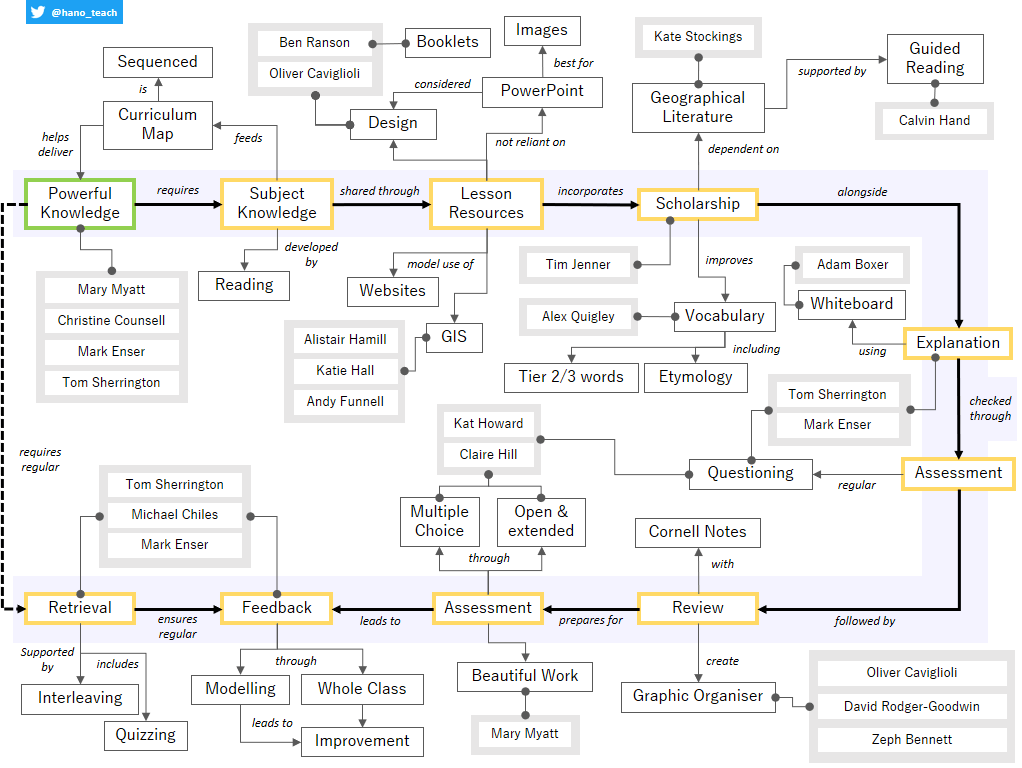
I am fortunate to work in a school where curriculum is at the heart of what we do. Departments are given incredible autonomy and over the past two years we have also been given a vast amount of time within our teams to talk openly and honestly about what we should teach. In geography, we agreed upon a cumulative story where students would be taken on a journey of the history of planet earth from its formation through to the Anthropocene. Being able to teach the geography that inspires and excites me has given me the motivation to work on how best to deliver this in the classroom.
Mary Myatt, Christine Counsell and Mark Enser – to name just a few whose work I have read recently – all refer to ‘powerful knowledge’. Our team see this as teaching our students unashamedly academic and challenging geographical content. This provides them with both a deep and broad understanding of our planet, its people and of the great web of interconnections between the two branches of our discipline. However, to do this well, we must first consider our own subject knowledge. This means I read as much as possible whether this be non-fiction books, news articles or geographical magazines. Twitter is another great tool for signposting excellent resources whilst also allowing teachers to engage with academics, researchers and writers. As a result, I continue to become a better geographer and this means I can think critically about our curriculum and ensure what we deliver is grounded in giving students a broad and deep understanding of the world.
Excellent subject knowledge enables teachers to bring scholarship to the classroom, as we learnt under the guidance of Tim Jenner when he was Head of Humanities at my school. Taking beautiful texts and rich academic writing directly to the students is proving to be a great way of inspiring young geographers. This is also developing students’ academic vocabulary and written communication (see the work of Alex Quigley for more on this). As I choose to avoid delivering lessons which are restricted to a sequence of PowerPoint slides, I include extended passages of geographical text in lessons. This has opened up a whole new way of sharing knowledge with students. Booklets can also be powerful resource and we have had great success in using Ben Ranson’s excellent work with our Year 7’s this year. I think it is important to note that planning great lessons can sometimes mean creating a selection of brilliant PowerPoint presentations but great lessons can also be delivered without a single slide being shared.
I mentioned in the introduction that Oliver Caviglioli and David Rodger-Goodwin have influenced me greatly this year but I must also acknowledge Adam Boxer and his work around using mini white boards and a visualiser to deliver explanations. I have only adopted this approach myself since September and again, have found this has had a significant impact on my practice. My explanations are now better paced and more deliberate and I am able to take students through the sequence of learning far more effectively with live modelling and dual coding playing a leading role. For example, I recently delivered explanations of plate margins, global atmospheric circulation and the hydrological cycle in this way.
Some things have not changed too much in recent years in my classroom but they have proven to work and, pleasingly, have also been promoted by a number of leading figures in our profession. Questioning is the most valuable weapon in my assessment armoury and I find my judgement of any student’s knowledge and understanding evolves from a subconscious review of their verbal answers following many questions over many weeks of lessons. Cold-calling and asking students to share what they have learnt or understood is essential to this process and should be one the most important areas to focus on in our lessons. One of my favourite questions is “Lukas, tell me what you understand about…” This may be more of a request than a question but either way, this allows me to assess what students are thinking about and their understanding of the topic. This also allows me to control what happens next and whether I can move forward or more input is required.
Finally, the power of modelling. I think it is common to hear this term and think of it as a ‘model answer’ but modelling is so much more. How we verbalise our ideas and frame explanations, how we demonstrate the links and connections we are constantly making, the vocabulary and key words we choose, and the way in which we present or write down our thoughts all require modelling if students are to get better within our lessons. Coupled with questioning to ensure our students are understanding what we are telling them, modelling helps them to communicate their knowledge effectively.
Ultimately, questioning and modelling can only be deployed successfully when underpinned with strong subject knowledge. Ensuring I ask the right questions and deliver clear and accurate explanations is incredibly important otherwise the act of including such practice in lessons is frivolous.
As this article only touches on some of my thoughts, I’ll end with a simple message which is subject knowledge and pedagogy should be seen as two parts of a whole and neither should be explored in isolation. This is how I teach powerful geography.
Top 5 tips…
- Continue to develop your subject knowledge by reading a range of materials and following the experts.
- Release yourself from the shackles of PowerPoint – not everything needs to be shared on a slide.
- Incorporate scholarship into lessons through rich academic texts and challenging vocabulary.
- Consider how your explanation may be enhanced by using a visualiser and dual coding techniques.
- Incorporate questioning and modelling into everything, all of the time but ensure it is underpinned by sound knowledge and understanding of the topic.
 teaching geography