Curriculum sequencing & thoughtful retrieval: It’s beginning to pay off

We’ve been working on our Key Stage 3 Geography curriculum for several years now and we are starting to see our efforts begin to pay off with regards to the deliberate sequencing of knowledge. In this short post, I am going to reflect on a single, but significant, moment from my last lesson of the term with a Year 8 class.

During this lesson, in which I was introducing the formation of the Sierra Nevada region in the USA, I included a retrieval task at the start of the lesson based on the image below.
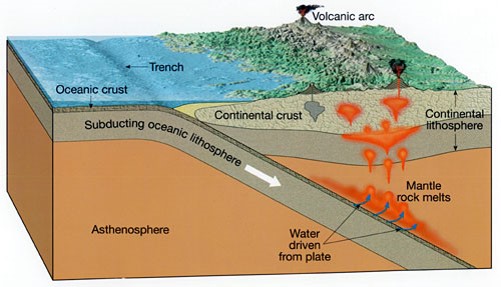
Diagram showing the process of subduction at a destructive plate margin

Students were asked to recall knowledge they had first acquired during Year 7 and had then covered again earlier in Year 8. Following a brief discussion and a little CFU (checking for understanding), I asked students to write an explanation of what was happening. I think it’s important to note that this wasn’t a quiz or list of 10 recall questions. Instead, this retrieval task required students to remember information and write several sentences to explain the sequence of events, not something which is easily done without reasonable knowledge and understanding of the processes involved.

Moving around the class, I was pleased to see the vast majority of students were able to confidently put pen to paper. The usual one-to-one support was needed in some parts of the room, but this was little more than a few prompts, questions or direction of how to start.

To provide students with feedback and ensure they had an opportunity to correct or improve their answers, I walked them through my answer whilst pointing to key features on the diagram. After each statement, I asked students to raise their hands if they had included a similar point, sentence or key term. Met with a sea of arms throughout most of my explanation, I was confident that we could move on to the focus of the current lesson, ‘How did the Sierra Nevada region form?’

The next phase of the lesson involved a full page of challenging text which included these opening paragraphs…

Study suggests parts of the Sierra Nevada formed in a “geologic instant,” more than twice as fast as previously thought.

Although we can’t see it in action, the Earth is constantly churning out new land. This can take place at subduction zones, where tectonic plates move towards each other and in the process create chains of volcanoes as one plate is forced under another. Some of this magma does not spew out, but instead mixes and morphs just below the surface. It then crystallizes as new continental crust, in the form of a mountain range.

Scientists have thought that the Earth’s mountain ranges are formed through this process over many millions of years. But MIT geologists have now found that the planet can generate new land far more quickly than previously thought.

By deliberately including this specific retrieval task at the start of the lesson, the opening passage of text was something the students already understood. Not only did this give them great confidence, but it meant they had an understanding of the vocabulary and, more importantly, an image in their minds of what was happening.

As we continued to read through the text, students had engaged their prior knowledge onto which they could attach new learning. This allowed for more effective learning of new knowledge but also the embedding of their previous understanding of the tectonic processes involved.

So how did we get to this stage?

During Year 7, we have written a unit which introduces tectonics for the first time and focusses on the physical processes occurring within the Earth’s interior. The process of subduction and the reasons why it happens are important. The basic concepts are introduced with regards to plate margins, and examples are shared from around the world Students participate in the drawing and labelling of diagrams, before being able to explain each type of margin.

A year later, in the early parts of Year 8, students revisit these ideas as they explore how ocean basins are created and destroyed. Here, the processes associated with plate movement are applied to the Wilson Cycle. Students once again are expected to use geographical vocabulary to explain processes, this time applying previous learning to a new area of geographical study.

So by the time these processes are brought in for a third time, during my lesson on Friday, most students were confident in their understanding and able to recall explanations with relative ease. At worst, some gentle prompting is required to get students on their way. Not only this, but I was then able to introduce even more complex disciplinary knowledge through a piece of challenging text. This would not have been possible had the relevant background understanding have not been available to students.

As 3pm arrived and the term came to an end, I was left with the pleasant thought that what we are doing is having a positive impact on learning with students now engaging with, and applying, geographical knowledge and understanding at a far higher level than I have experienced previously. I can’t think of a better way to head in to the school holidays!

Reflection

  • Retrieval practice does not have to be a quiz or series of recall questions. Instead, students can focus on one area of prior learning, shared through an appropriate task/format, to activate this for the current lesson.
  • The deliberate sequencing of the curriculum is essential if important ideas and concepts are to be learned, embedded and built upon over time.
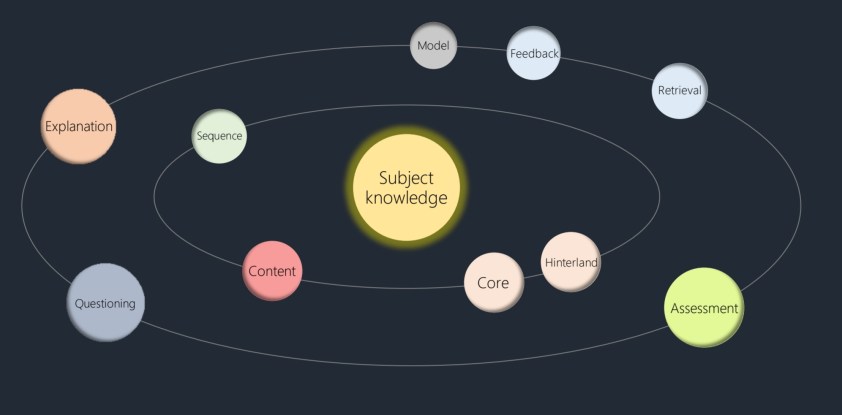
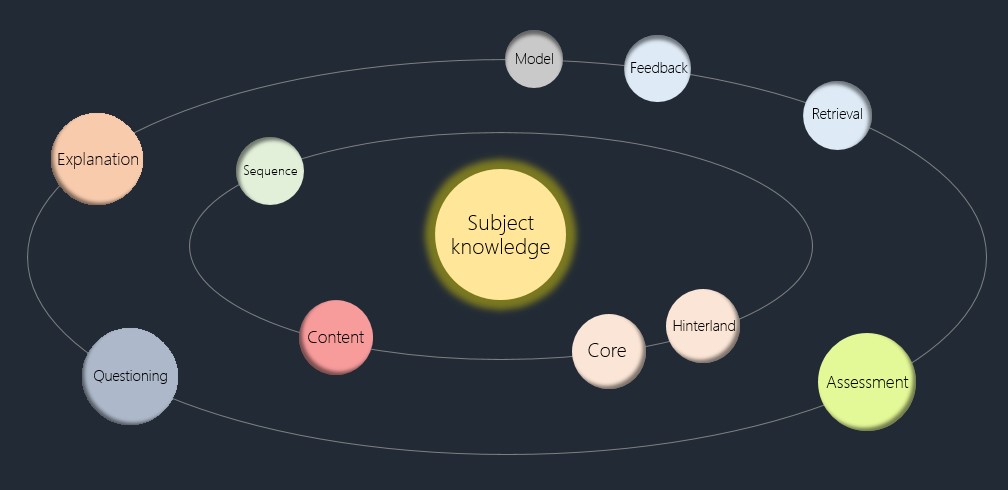
The Sun at the centre of the curriculum

The Sun’s gravitational force holds the solar system together whilst also providing light and heat. Without light and heat, there would be no life on Earth. The Sun is very important. There are also a number of other very important features within the solar system – planets, dwarf planets, moons, asteroids, comets, and meteors but it is the Sun, in the centre, that holds everything in place.

What has this got to do with curriculum?

Let us imagine the curriculum to be similar to the model of the solar system. Just as the Sun is at the centre of the solar system, subject knowledge is at the heart of the curriculum. It is our knowledge of the subject that underpins everything we do and it is knowledge that holds everything else in place.

Delivering an effective explanation, asking excellent questions or implementing rigorous assessments are all essential to delivering a strong curriculum yet none of these, or the other key areas of our practice, are as effective if they are not firmly rooted in a deep and broad knowledge of the subject.

More and more teachers are now basing their practice on educational research and many schools have adopted this approach when creating teaching and learning policies but we must pause and remember that this is not necessarily enough in itself. We need to stop and ask ourselves what makes an explanation effective? What makes a question excellent? What makes an assessment rigorous? Of course pedagogy needs careful consideration, and we must all continue to develop this, but underneath it all is the subject knowledge of an expert.

So throwing a retrieval quiz into the start of a lesson because this is seen as good practice isn’t actually good enough unless those questions are based on content that has been carefully selected. Retrieval also needs to be delivered in such as way as to develop students’ understanding and assist them in generating meaning. If we are not careful, we are simply enforcing that remembering a collection of facts is enough when this isn’t how you become a great geographer, for example.

Likewise, the teacher who asks most of the students in the room a question through cold calling is seen as doing something good. Again though, these questions must be designed not simply to check what has been remembered over the last 5 minutes but must help students understand what this information means and how it is part of the bigger picture.

With this in mind, we need to see more teachers spending their time reading and discussing their subject. In fact, we need schools to allow teachers to to spend more time reading and discussing their subject. Rather than using planning time and meetings to complete arbitrary tasks, how amazing would it be to sit together sharing thoughts on a recent publication or wrestling with each other about the content to be selected for the next unit in Year 8?

Everything we do is important but remember, the Sun is at the centre of the solar system.

Chapter overviews: focus on the core and hinterland

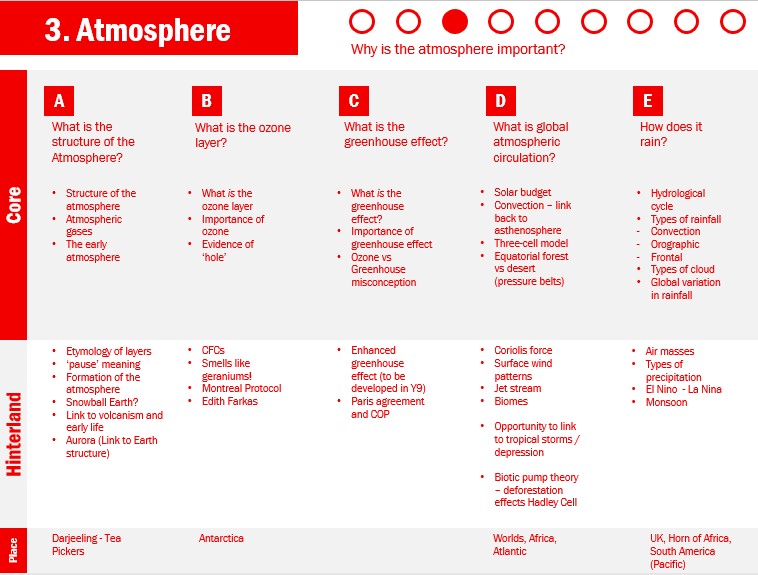
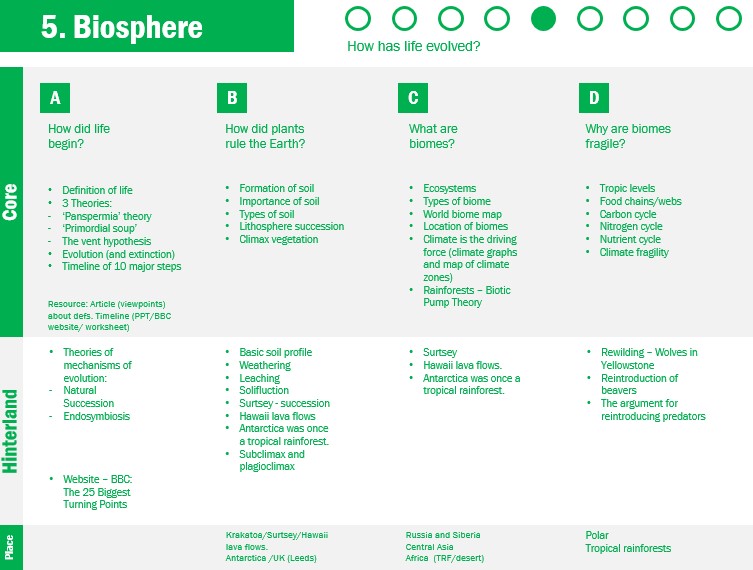
Last year, I introduced the idea of chapter overviews to our team. These would become single-page documents providing a brief summary of the content of each of the units we teach at KS3. We call the units we teach ‘chapters’ as collectively, they form our curriculum story. Although we have also created extensive schemes of learning which can span several pages, when combined to view the full curriculum, this can make for a rather hefty document. On a day-to-day basis, this level of detail is beyond the need of a busy teacher who is simply checking in on the core content to be covered over the next few lessons.

The chapter overviews provide us with a simple, accessible guide to keep us all on track and ensure we are delivering our curriculum consistently across the department.

Three Themes

Each chapter overview contains three main elements. This is what we want each teacher to be mindful of when delivering their lessons. These elements are the key questions, core knowledge and hinterland knowledge.

During our planning meetings, everyone is involved in the discussion regarding the key questions each chapter should cover. As you can imagine, this is never a quick task as we wrestle with ideas and quite often, each other! From here we then determine the core content. This, as Christine Counsell writes, can be described as “the ‘residue’ – the things that stay, the things that can be captured”. At this stage we are thinking about long term knowledge and the bigger picture. What do we want our students to know in one month, one year or five years? We are lucky to have two geography lessons a week in KS3 and three hours in KS4 but even with this relatively generous allocation, refining the core content in such a way as to provide breadth and depth can be extremely difficult and involves many lengthy and challenging conversations.

Once we have agreed upon the core, we then turn our thinking to the hinterland – the wider narrative in which the core sits. The hinterland is a really important element in the curriculum and it certainly isn’t a case of each teacher sharing whatever supplementary content they wish. We deliberate over this content in the same way we debate what is included in the core. The hinterland may include reference to famous geographers, topical events, specific case studies or simply really interesting geography that we don’t need students to learn at this stage to progress through the curriculum but we share it anyway. The hinterland is quite often learning for the sake of learning. I like to think of the hinterland as the supporting actor – would Pulp Fiction have been as good without Samuel L Jackson? Ultimately, ignore the hinterland and you may be left with a curriculum that reads more like a revision guide than a beautiful book.

Although many of our chapter overviews are still at an early stage and will continue to be edited over coming months and years, they have proven to be extremely useful to date. It is clear from department meetings that our shared vision for our curriculum is now being delivered to students more consistently. Better still, our resources are no longer the scheme. In the past it has been too easy to see the PowerPoint, or series of presentations, as the lesson plan or scheme of the learning. The issue with this is teachers are thinking about slide design, tasks or other important lessons features such as model answers or opportunities for assessment when creating a lesson resource and the content can become obscured. Although this thought process is essential when designing a lesson, it is not necessarily helpful when initially thinking about the content to be covered over the coming weeks. The chapter overviews have provided a simple one-page summary acting as the bridge between the larger schemes of learning and the individual lesson resources.

In time, I can see these pages evolving and possibly containing a reverse side with procedural knowledge, more detailed case studies and examples, key vocabulary and assessment opportunities. For now though, they are serving their intended purpose – to offer a quick-look guide into our curriculum and ensure we don’t miss the core or get lost in the hinterland.