Curriculum sequencing & thoughtful retrieval: It’s beginning to pay off

We’ve been working on our Key Stage 3 Geography curriculum for several years now and we are starting to see our efforts begin to pay off with regards to the deliberate sequencing of knowledge. In this short post, I am going to reflect on a single, but significant, moment from my last lesson of the term with a Year 8 class.

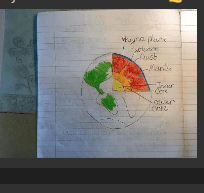
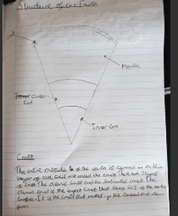
During this lesson, in which I was introducing the formation of the Sierra Nevada region in the USA, I included a retrieval task at the start of the lesson based on the image below.
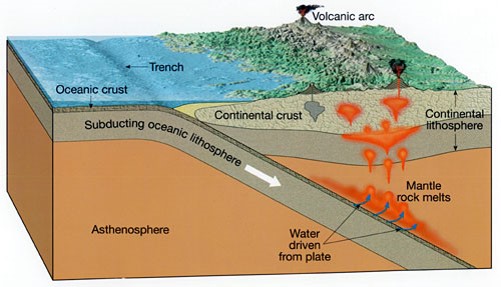
Diagram showing the process of subduction at a destructive plate margin

Students were asked to recall knowledge they had first acquired during Year 7 and had then covered again earlier in Year 8. Following a brief discussion and a little CFU (checking for understanding), I asked students to write an explanation of what was happening. I think it’s important to note that this wasn’t a quiz or list of 10 recall questions. Instead, this retrieval task required students to remember information and write several sentences to explain the sequence of events, not something which is easily done without reasonable knowledge and understanding of the processes involved.

Moving around the class, I was pleased to see the vast majority of students were able to confidently put pen to paper. The usual one-to-one support was needed in some parts of the room, but this was little more than a few prompts, questions or direction of how to start.

To provide students with feedback and ensure they had an opportunity to correct or improve their answers, I walked them through my answer whilst pointing to key features on the diagram. After each statement, I asked students to raise their hands if they had included a similar point, sentence or key term. Met with a sea of arms throughout most of my explanation, I was confident that we could move on to the focus of the current lesson, ‘How did the Sierra Nevada region form?’

The next phase of the lesson involved a full page of challenging text which included these opening paragraphs…

Study suggests parts of the Sierra Nevada formed in a “geologic instant,” more than twice as fast as previously thought.

Although we can’t see it in action, the Earth is constantly churning out new land. This can take place at subduction zones, where tectonic plates move towards each other and in the process create chains of volcanoes as one plate is forced under another. Some of this magma does not spew out, but instead mixes and morphs just below the surface. It then crystallizes as new continental crust, in the form of a mountain range.

Scientists have thought that the Earth’s mountain ranges are formed through this process over many millions of years. But MIT geologists have now found that the planet can generate new land far more quickly than previously thought.

By deliberately including this specific retrieval task at the start of the lesson, the opening passage of text was something the students already understood. Not only did this give them great confidence, but it meant they had an understanding of the vocabulary and, more importantly, an image in their minds of what was happening.

As we continued to read through the text, students had engaged their prior knowledge onto which they could attach new learning. This allowed for more effective learning of new knowledge but also the embedding of their previous understanding of the tectonic processes involved.

So how did we get to this stage?

During Year 7, we have written a unit which introduces tectonics for the first time and focusses on the physical processes occurring within the Earth’s interior. The process of subduction and the reasons why it happens are important. The basic concepts are introduced with regards to plate margins, and examples are shared from around the world Students participate in the drawing and labelling of diagrams, before being able to explain each type of margin.

A year later, in the early parts of Year 8, students revisit these ideas as they explore how ocean basins are created and destroyed. Here, the processes associated with plate movement are applied to the Wilson Cycle. Students once again are expected to use geographical vocabulary to explain processes, this time applying previous learning to a new area of geographical study.

So by the time these processes are brought in for a third time, during my lesson on Friday, most students were confident in their understanding and able to recall explanations with relative ease. At worst, some gentle prompting is required to get students on their way. Not only this, but I was then able to introduce even more complex disciplinary knowledge through a piece of challenging text. This would not have been possible had the relevant background understanding have not been available to students.

As 3pm arrived and the term came to an end, I was left with the pleasant thought that what we are doing is having a positive impact on learning with students now engaging with, and applying, geographical knowledge and understanding at a far higher level than I have experienced previously. I can’t think of a better way to head in to the school holidays!

Reflection

  • Retrieval practice does not have to be a quiz or series of recall questions. Instead, students can focus on one area of prior learning, shared through an appropriate task/format, to activate this for the current lesson.
  • The deliberate sequencing of the curriculum is essential if important ideas and concepts are to be learned, embedded and built upon over time.
How I teach geography…

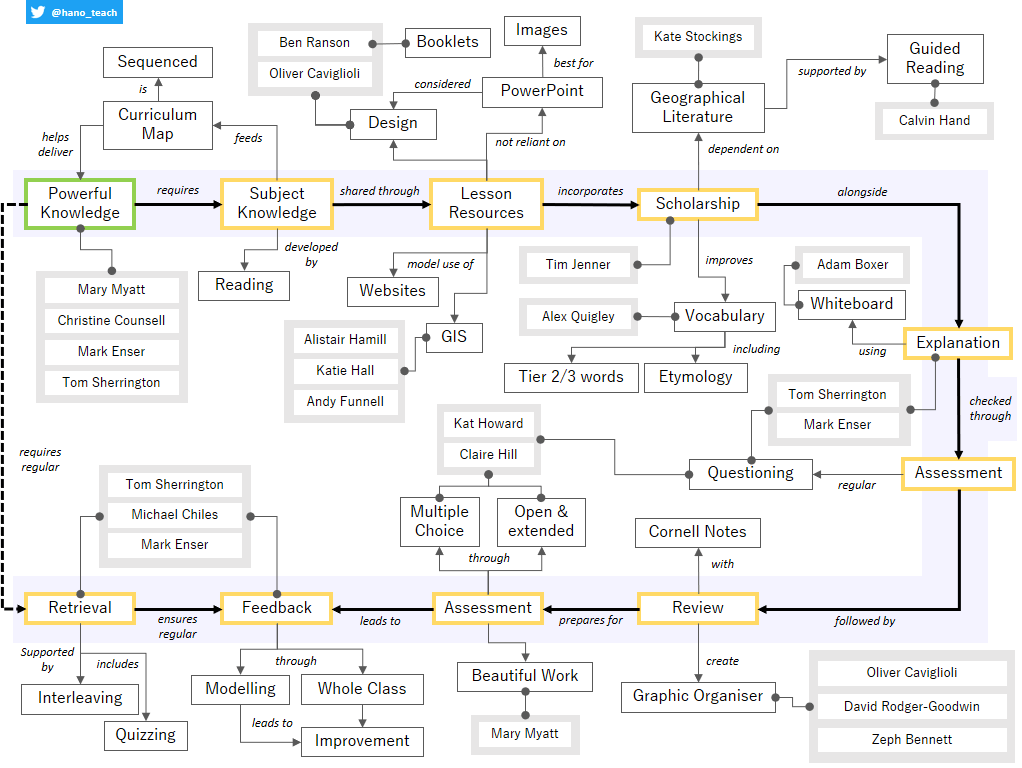
Having taught geography in the same school for 10 years, the first national lockdown in March 2020 provided an opportunity to reflect on, and refine, many aspects of my teaching practice. In this short article I will outline my approach to teaching geography. Some of these insights have evolved over time, whereas some have developed more recently thanks to the work of others. For example, Oliver Caviglioli and David Rodger-Goodwin’s work on graphic organisers have inspired my teaching practice and helped me to codify my ideas about teaching geography, as shown below. Indeed, I will also include reflections on other approaches which I myself am only trying for the first time. 

I am fortunate to work in a school where curriculum is at the heart of what we do. Departments are given incredible autonomy and over the past two years we have also been given a vast amount of time within our teams to talk openly and honestly about what we should teach. In geography, we agreed upon a cumulative story where students would be taken on a journey of the history of planet earth from its formation through to the Anthropocene. Being able to teach the geography that inspires and excites me has given me the motivation to work on how best to deliver this in the classroom. 

Mary Myatt, Christine Counsell and Mark Enser – to name just a few whose work I have read recently – all refer to ‘powerful knowledge’. Our team see this as teaching our students unashamedly academic and challenging geographical content. This provides them with both a deep and broad understanding of our planet, its people and of the great web of interconnections between the two branches of our discipline. However, to do this well, we must first consider our own subject knowledge. This means I read as much as possible whether this be non-fiction books, news articles or geographical magazines. Twitter is another great tool for signposting excellent resources whilst also allowing teachers to engage with academics, researchers and writers. As a result, I continue to become a better geographer and this means I can think critically about our curriculum and ensure what we deliver is grounded in giving students a broad and deep understanding of the world. 

Excellent subject knowledge enables teachers to bring scholarship to the classroom, as we learnt under the guidance of Tim Jenner when he was Head of Humanities at my school. Taking beautiful texts and rich academic writing directly to the students is proving to be a great way of inspiring young geographers. This is also developing students’ academic vocabulary and written communication (see the work of Alex Quigley for more on this). As I choose to avoid delivering lessons which are restricted to a sequence of PowerPoint slides, I include extended passages of geographical text in lessons. This has opened up a whole new way of sharing knowledge with students. Booklets can also be powerful resource and we have had great success in using Ben Ranson’s excellent work with our Year 7’s this year. I think it is important to note that planning great lessons can sometimes mean creating a selection of brilliant PowerPoint presentations but great lessons can also be delivered without a single slide being shared. 

I mentioned in the introduction that Oliver Caviglioli and David Rodger-Goodwin have influenced me greatly this year but I must also acknowledge Adam Boxer and his work around using mini white boards and a visualiser to deliver explanations. I have only adopted this approach myself since September and again, have found this has had a significant impact on my practice. My explanations are now better paced and more deliberate and I am able to take students through the sequence of learning far more effectively with live modelling and dual coding playing a leading role. For example, I recently delivered explanations of plate margins, global atmospheric circulation and the hydrological cycle in this way. 

Some things have not changed too much in recent years in my classroom but they have proven to work and, pleasingly, have also been promoted by a number of leading figures in our profession. Questioning is the most valuable weapon in my assessment armoury and I find my judgement of any student’s knowledge and understanding evolves from a subconscious review of their verbal answers following many questions over many weeks of lessons. Cold-calling and asking students to share what they have learnt or understood is essential to this process and should be one the most important areas to focus on in our lessons. One of my favourite questions is “Lukastell me what you understand about…” This may be more of a request than a question but either way, this allows me to assess what students are thinking about and their understanding of the topic. This also allows me to control what happens next and whether I can move forward or more input is required.  

Finally, the power of modelling. I think it is common to hear this term and think of it as a ‘model answer’ but modelling is so much more. How we verbalise our ideas and frame explanations, how we demonstrate the links and connections we are constantly making, the vocabulary and key words we choose, and the way in which we present or write down our thoughts all require modelling if students are to get better within our lessons. Coupled with questioning to ensure our students are understanding what we are telling them, modelling helps them to communicate their knowledge effectively. 

Ultimately, questioning and modelling can only be deployed successfully when underpinned with strong subject knowledge. Ensuring I ask the right questions and deliver clear and accurate explanations is incredibly important otherwise the act of including such practice in lessons is frivolous.  

As this article only touches on some of my thoughts, I’ll end with a simple message which is subject knowledge and pedagogy should be seen as two parts of a whole and neither should be explored in isolation. This is how I teach powerful geography

Top 5 tips… 

  1. Continue to develop your subject knowledge by reading a range of materials and following the experts. 
  1. Release yourself from the shackles of PowerPoint – not everything needs to be shared on a slide. 
  1. Incorporate scholarship into lessons through rich academic texts and challenging vocabulary. 
  1. Consider how your explanation may be enhanced by using a visualiser and dual coding techniques. 
  1. Incorporate questioning and modelling into everything, all of the time but ensure it is underpinned by sound knowledge and understanding of the topic. 

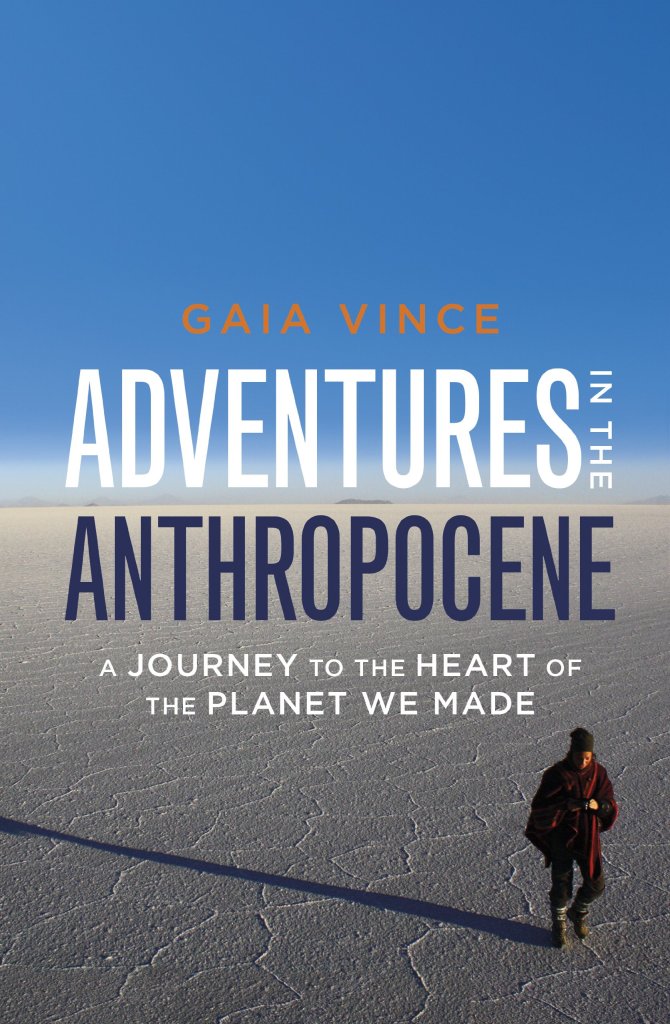
Adventures in the Anthropocene

Gaia Vince (2014)

Anatomically modern humans didn’t arrive until nearly 200,000 years ago and it was touch and go whether we would survive. But something pulled us through, the something that differentiated us from other species in this shared biosphere and made us so successful that we now rule our world: the human brain.”

“So humankind is making a pretty distinctive mark on the living planet. Nowhere on Earth is truly wild or pristine anymore – everywhere has been touched by humans in some way”

Why this book?

This is the ultimate book to weave through your entire geography curriculum. Gaia Vince’s Adventures in the Anthropocene takes the reader on an extraordinary journey around the world investigating the challenges and opportunities we face heading into the Anthropocene – the ‘Age of Man’. In the 4.5 billion years of the planet’s history, human activity is on a par with the greatest natural events in terms of changing the physical characteristics of the world in which we inhabit. The scale and speed of our impact on the planet has been phenomenal since World War Two and in this time, known as the Great Acceleration, we have made epoch defining changes to the spheres of Earth which are explored eloquently by Gaia throughout.

Constructed of ten fascinating chapters: Atmosphere; Mountains; Rivers; Farmlands; Oceans; Deserts; Savannahs; Forests; Rocks; Cities, each one offers much more than the simple titles would suggest. This book is the perfect companion to any geography curriculum providing the real-world examples we often seek to bring the content of our lessons alive.

Each chapter opens with a beautifully written geographical overview which provides an exciting introduction before Gaia’s journey continues. The sheer volume of subject specific vocabulary is noteworthy and will expose students to an extensive range of tier two and three words. The brief introductory passages can also be used in their own right in the classroom and will be especially useful for teachers who appreciate a ‘hook’ at the start of a unit.

This book is a masterful combination of travel writing, interviews and geographical discussion making it a must-read for every geography teacher.

For students:

P.1*“Four and a half billion years ago, out of the dirty halo of cosmic dust left over from the creation of our sun, a spinning clump of minerals coalesced. Earth was born, the third rock from the sun.”

The introduction to Adventures in the Anthropocene offers a succinct description of Earth’s incredible history and our place within it. Although you are strongly advised to read the entire book, this short summary will give you a strong understanding of how human actions are altering the natural world and what we can expect of our furture.

P.266 “As scientists and conservationists, we need to recognise that we’ve failed: Galapagos will never be pristine”

If you have an interest in ecology and conservation, find out about the challenges facing the people trying the manage some of the most wondrous islands on the planet where Charles Darwin carried out his research. Conservation is not as straightforward as we might think and this passage will give you an insight into some of the scientific debates taking place.

P.317 “There is a small cluster of low, unheated stone hovels clinging to the mountainside and between them is the low dark entrance, stained black with llama blood, remnant of a sacrifice to the Tio (the Devil) made a couple of weeks ago. Miners are extremely superstitious creatures…”

We live in a world dominated by technology and it plays a huge part in all our lives (tablets, phones, watches, smart speakers, coffee machines etc.) but all these gadgets come at a price. Take a tour through a Bolivian silver mine to discover the human and ecological costs of our much-loved tech.

P.330 “Kyle Wiens is the sophisticated electronics tinkerer that the industry emperors like Microsoft and Apple dream of employing. But Kyle is a guerrilla geek – he slipped through their net and crossed over to the consumer side.”

There is another way! Rather than complying with the throwaway society around us, why not consider what you can do to tackle these issues. This part of the book investigates the make-do-and-mend culture that we need to reignite in an attempt to conserve resources and make the most of those already exploited.

*page numbers are from Penguin Vintage Classics edition (2019)

For teachers:

The book is brimming with case studies from different locations around the world. In terms of geographical content, there is incredible breadth and depth. Each chapter, though quite lengthy, can be treated as a standalone text making the book much more accessible for the time-limited teacher to take what they need, when they need it.

Students will be captivated by the opening passages of each chapter but they will particularly enjoy experiencing the lives of a number of fascinating individuals and the unique stories shared. These anecdotes will support students in their understanding of the content which is suitably challenging. Mahabir Pun (Atmosphere), a local hero helping to bring Wi-Fi and toilets to an isolated Nepalese village, Rosa Maria (Forests), a sixty year-old risking her life in Bolivia whilst fighting to save the tropical rainforest biome and Hardevsinh Jadeja (Farmland), a village chief in India providing a sustainable water supply despite climatic challenges, are just a few of the characters amongst many who brighten the pages of what could otherwise be a pessimistic read.

Human demand for resources – food, water and energy – underpin much of the book as our ever-increasing needs lead to continued exploitation of the planet and result in accelerated changes in the natural world. However, there are many moments of optimism as stories of adaptation and human innovation are explored frequently including conservation projects in the Amazon, sustainable development in the Maldives and artificial glaciers in the Himalayas.

The epilogue will also be of interest to students as Gaia shares a prediction of the world in 2100 through the eyes of her son, Kipp, at 87 years old. This is a great opportunity for students to make their own predictions for the future and consider how we will adapt to the many challenges we have largely been responsible for.

If you want to incorporate more geographical text into your lessons, Adventures in the Anthropocene is the book for you.

This review was originally written as a guest post for Kate Stocking’s ‘On my bookshelf’ https://www.katestockings.com/geographybooks

I know they are there, but are they?

One of the many challenges of remote learning so far has been assessing the extent to which students are participating in online learning. In the classroom, a quick glance around the room allows us to quickly judge what is going on but when we’re all hidden away, interaction with students can feel…well, remote.

To tackle this I have been exploring a few different techniques in a bid to increase engagement during the lesson and, more importantly, see it. As I am teaching a fully live timetable, this is particularly important in very much the same way it would be in a classroom setting.

I’ve seen lots of posts on Twitter championing class interaction through Jamboard and live editing in Google Slides. Although these look really great, and are working well for those people, there were a couple of issues for me. Firstly, we are using Microsoft Teams which means not all software has an equivalent on this platform (or I haven’t discovered it!) and secondly, a lot of what I have seen looks a little fiddly and would add to the time required to prepare for each lesson. I’m not a Luddite but I also don’t want to find myself spending much of my time outside of lessons creating new resources for all of my classes or setting up templates etc.  

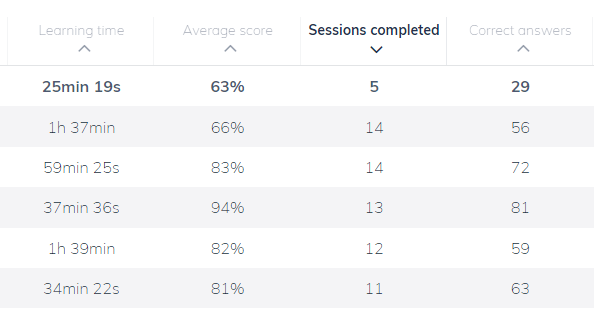
I’m a huge fan of Seneca learning and most of my classes are directed to use this site, especially at GCSE. We have used Seneca for a few years now and find it works well. I particularly like being able to peek behind the scenes and see how students are getting on with their revision. Taking a look at the ‘students’ page (below) is very useful for assessing student activity. I can see how much time students are spending on Seneca as well as how successfully they have completed each section. However, Seneca is a great tool but it doesn’t solve my live lesson problem.

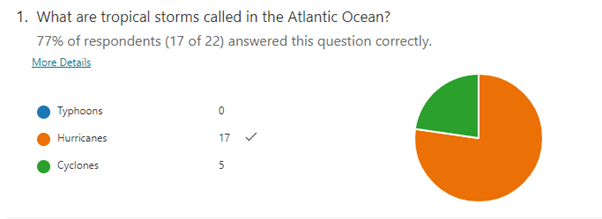
We recently introduced weekly quizzes through Microsoft Forms. I can create simple, self-marking quizzes containing a mix of question styles and they are great for assessing knowledge. The response summary page provides an overview of how classes answered individual questions (below) so I can decide whether or not something needs a brief recap or further explanation. I can also take a more detailed look at an individual student’s answers and see how they fared. The quizzes are really good and we will continue to use them but they require quite a bit of work in advance and don’t allow me to instantly interact with students.

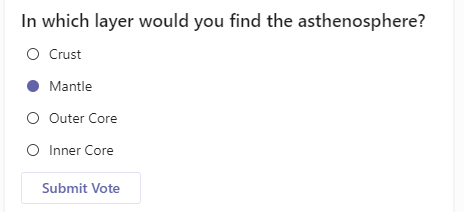
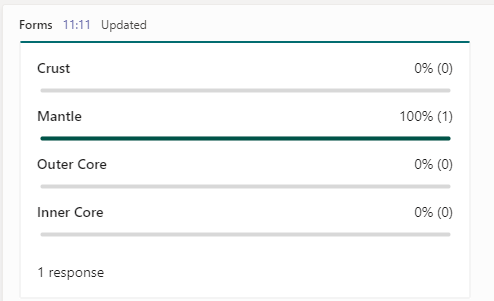
A colleague discovered a short-cut to quickly add a quiz question or poll during a live lesson. By simply typing “@form” in a new post, a question can be created and instantly shared with students. This is useful when wanting the responses to one or two questions during a lesson as it enables me to see how many students are participating and whether they have understood what has been taught. Again though, this isn’t perfect as the question has to be created on the main class page in Teams and doesn’t work in the live chat feed so it means switching between screens. This is a useful tool and does a job but I won’t be relying on it for lots of active participation during the lesson, instead I will use it for brief and occasional feedback from students.

The more I deliver live lessons, the more comfortable I feel navigating and sharing various screens. I now ensure the live chat is visible to me at all times (I know some colleagues have this on a second screen or device) and promote engagement be requesting questions from students in the same way I would invite questions in the classroom. My students are clearly becoming more comfortable as well and I am experiencing more purposeful ‘chat’ participation week-on-week. I particularly enjoy seeing students responding to each other and building on or challenging answers. My lessons now regularly involve questions which I will deliver verbally followed by an instruction for all students to type their answer into the chat but not press send. I then give a countdown 3, 2, 1… and all students submit their answer at the same time. It’s a little hectic with larger classes but I can often spot mistakes and provide feedback. It’s not easy to see if everyone has taken part but it is an indicator of student involvement and promotes friendly competition. As well as asking everyone for an answer, the live chat is also really useful for cold-calling, if you can bear a few moments of silence when a student delays in sending their response!

I have also found the live chat is a useful space to ask students to update me on their progress when completing extended tasks. If I give students over 15 minutes to do something, it can be rather unnerving to let them get on without being able to watch them work. To alleviate my angst, I request that students share a screen shot or photo of their work part way through the task (below). This is beneficial for the students as well as they can see how they are getting on compared to their peers in much the same way as they would by glancing around the room at school.

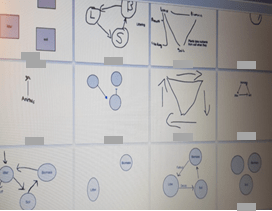
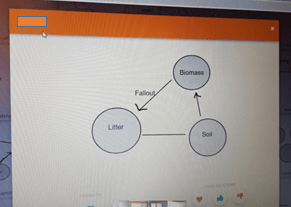
Finally, we could have a game-changer! Scrolling through Twitter I stumbled across a post by Mark Roberts (@mwrgeography). Mark shared the website whiteboard.fi which allows a teacher to create a temporary, virtual classroom and share a link with students. Students open the link and have access to a virtual whiteboard which they can type, write or draw on. I used this for the first time today and was incredibly excited when I saw everyone in the class working in real time. Not only had it taken me no time at all to create and share the link but on the whole, students could access the site and complete the work on any device. I must add, it wasn’t perfect and some students experienced ‘glitching’ or parts of their answer disappeared but overall, the feedback was positive and it was the first time I have been able to set a task and watch everyone complete it. I could share my screen and show them what I could see as well as opening individual pieces of work to model good practice (below).

There are plenty of excellent tools out there but if, like me, you want something quick and easy to use in lessons then I would recommend whiteboard.fi. Clearly, I haven’t used it much yet but so far it seems to be just what I was looking for and will allow me to monitor and promote engagement in my live lessons.